Start of screen-reader friendly text version.
POINT Newspaper Article
URL: epaper.truepointnews.com
Date: 15 Aug 2026 - Page 7
Issue Details: Issue Vol. 1 - No. 34 | RNI No. APENG/2024/86608 | Weekly | 11 Pages | Price Rs. 3.00 | Copyleft
Grassroots Whistleblower Movement to Straight India's Economic Trajectory
India @ 80
By Ram Kamal
Social Engineer
Part 4/5
India @ 80 is currently securing a bright economic future, but there is ambiguity regarding leadership after Prime Minister Modi and whether economic benefits are truly reaching the most marginalized citizens. This disparity necessitates a re-evaluation of India's economic model to suit present and future needs. We need to have a leader who is courageous enough to stop the counterfeit currencies and tax evasions. We are now at peak in collecting tax and spending too. But it is time to have an Economic policy for the nation that is flexible and forward looking.
During the Constituent Assembly debates, Dr. B.R. Ambedkar opposed locking the Constitution into a rigid "socialist" framework, arguing that future generations should have the flexibility to choose their own economic governance. However, in 1976, Prime Minister Indira Gandhi inserted the terms "socialist" and "secular" into the Preamble to support her "Garibi Hatao" poverty alleviation program. This one mini constitution has now become a major financial burden under the pretext of welfare and systemic leakage. Today, India spends approximately 960,207* Crores annually on welfare activities, yet nearly half of these funds end up in the wrong hands and Gharibi is still Gharibi, because they are not getting any welfare. Addressing this massive expenditure requires comprehensive audits. The government must ensure that only eligible citizens receive funds, while those who have escaped poverty should be integrated into the tax base to aid nation-building. It is high time India to implement 'Economic Reservations' rather than the caste-based ones.
Persistent Roots of Corruption
While top-level political corruption has significantly decreased under the current administration, grassroots and individual bribery continue to flourish. A 2020 Transparency International study noted that 39% of Indians had recently paid bribes for public services, which is an improvement from 62% in 2005, but still highlights a pervasive issue. Even with digital initiatives like Direct Benefit Transfers (DBT) removing traditional middlemen, corrupt officials and agents continue to find loopholes to demand bribes. The primary avenues for this ongoing corruption include:
- Public Services and Extortion: Middlemen facilitate daily bribery within the bureaucracy, often acting on behalf of top-level bureaucrats who delay processes to manipulate tenders.
- Highway Extortion: The trucking sector is heavily victimized, facing constant extortion at police and regulatory checkpoints despite reforms like GST. Truckers pay an estimated ?222 crore in bribes annually, and 60% of forced stoppages are designed solely for extortion, causing massive productivity delays.
- Welfare Siphoning: High-profile schemes like the National Rural Health Mission and MGNREGA suffer from immense financial leakage. Corrupt officials frequently pocket wages assigned to fake rural workers, which degrades infrastructure quality and stalls poverty reduction. Furthermore, secondary extortion persists at local panchayat levels, where officials demand bribes simply to issue beneficiary cards.
- Public Procurement: State-funded infrastructure projects are often hijacked by cabals of corrupt officials, politicians, and contractors. Their tactics include collusive bidding, price inflation, and routing funds through shell companies.
- Resource Monopolies: Historically, opaque administration led to monumental losses, such as the 2012 Coal Allocation Scam, though such resource allocations are under stricter scrutiny today.
- Corporate Favoritism: Political authority is sometimes leveraged to favor specific corporate monopolies, a practice ironically criticized by opposition leaders who engaged in the same behavior when in power.
A Grassroots Whistleblower Movement
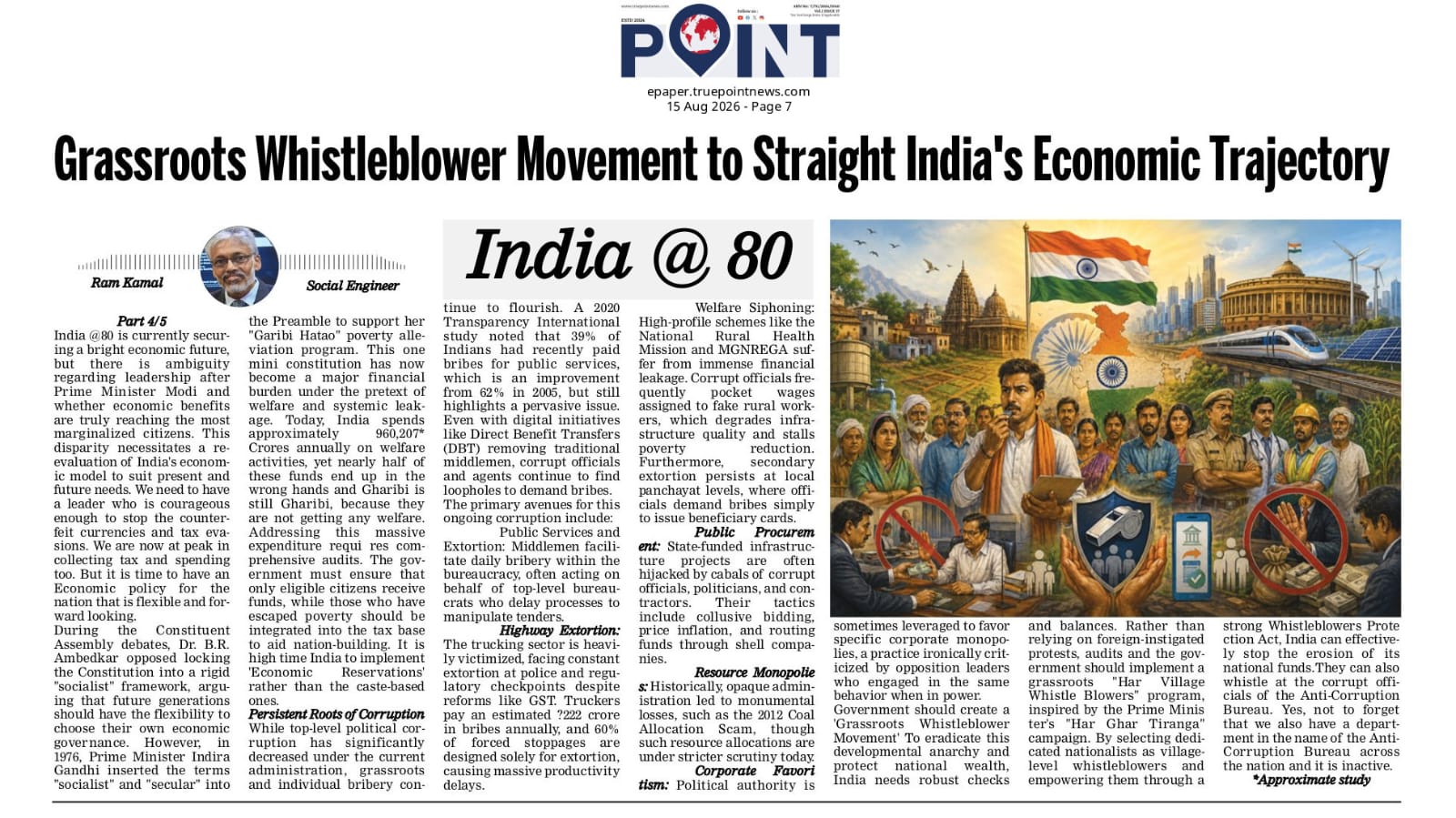
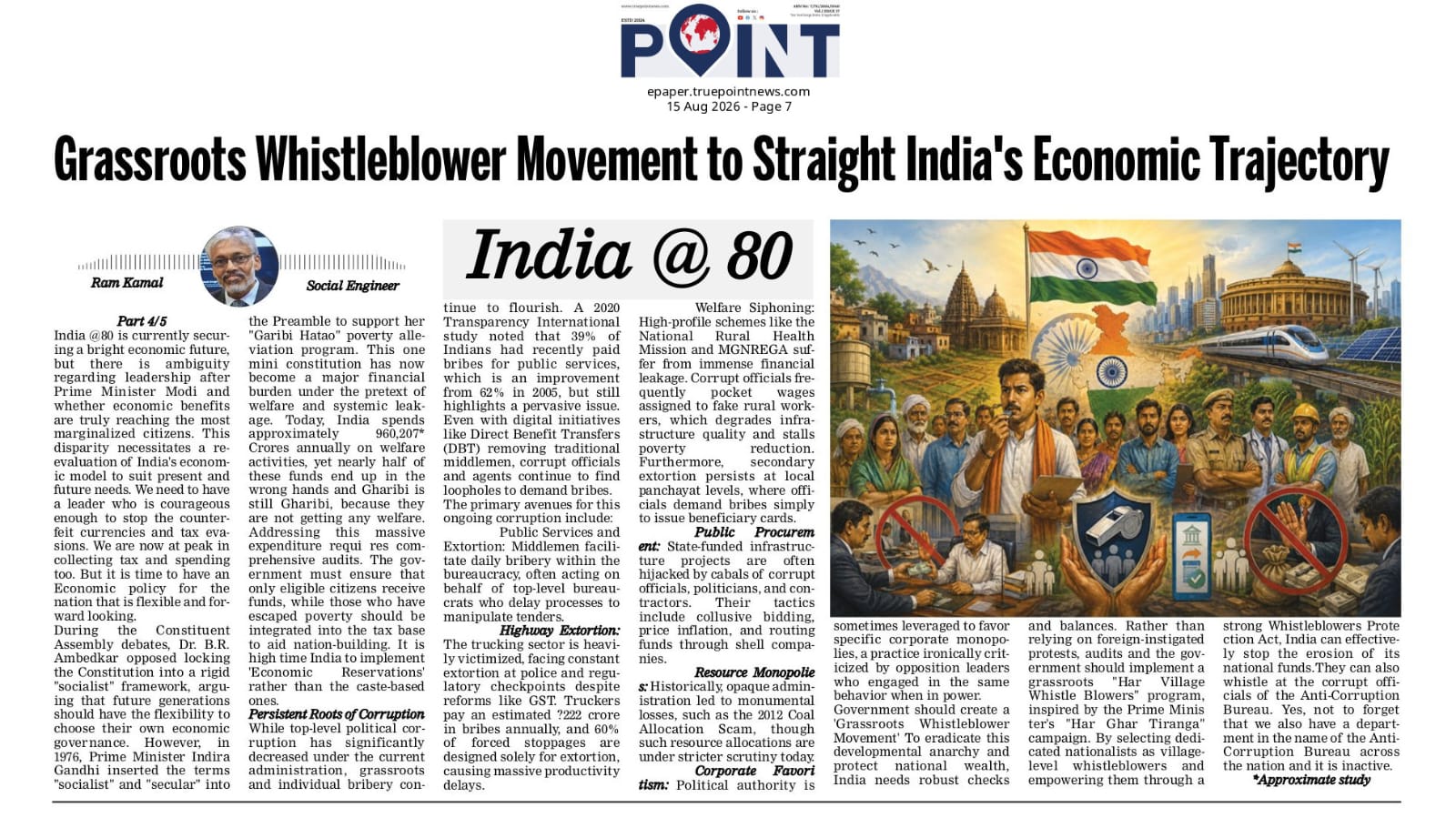
To eradicate this developmental anarchy and protect national wealth, India needs robust checks and balances. Rather than relying on foreign-instigated protests, audits and the government should implement a grassroots "Har Village Whistle Blowers" program, inspired by the Prime Minister's "Har Ghar Tiranga" campaign. By selecting dedicated nationalists as village-level whistleblowers and empowering them through a strong Whistleblowers Protection Act, India can effectively stop the erosion of its national funds. They can also whistle at the corrupt officials of the Anti-Corruption Bureau. Yes, not to forget that we also have a department in the name of the Anti-Corruption Bureau across the nation and it is inactive.
*Approximate study
Visual Description
On the right side of the layout, a colorful montage illustration depicts India's modern progress, technology, and national identity. It features a modern high-speed train traveling on elevated tracks, skyscrapers, wind turbines, and solar panels under a bright sky with the Indian national flag. In the foreground, a group of diverse Indian citizens is represented, including a farmer, a female scientist or professional, a military officer, a laborer, and other citizens looking forward with determination. Icons representing justice (scales) and governance are integrated at the bottom right of the graphic.
End of screen-reader friendly text version.