Start of screen-reader friendly text version.
POINT
EPAPER.TRUEPOINTNEWS.COM 14 AUG 2026 - PAGE 7
VIJAYAWADA, FRIDAY, AUGUST, 14, 2026
INDIA
WWW.TRUEPOINTNEWS.COM
The Vision of a Healthy India Is Very Personal. Promote, You're the Cure
(Part 3/5)
India recently surpassed China to become the world's most populous country, now home to approximately 1.478 billion people. While the nation has established data and development programs aiming to become a fully developed "Vikasit Bharat" by 2047, achieving this milestone requires a fundamentally healthy population. Based on current personal health data, there is a looming threat that the country will instead be overwhelmed by lifestyle diseases and sickness. To truly succeed, government policies must prioritise per capita wellness rather than just per capita income and industrial growth.
Healthcare Infrastructure and Economics
Furthermore, medical education in India has become a massive investment game. Parents often go bankrupt paying for coaching centres to secure admissions for their children, driven by the desire for them to become doctors or engineers regardless of economic standing. Consequently, young doctors frequently pursue high-earning specialisations to recoup these costs, losing sight of the Hippocratic Oath and the core value of service.
In one of my meetings for a project dedicated to prevention in 2018, top health officials expressed immense pride in India's development of new AIIMS, nationwide multispecialty hospitals designed to compete with private healthcare giants. However, this strategy relies
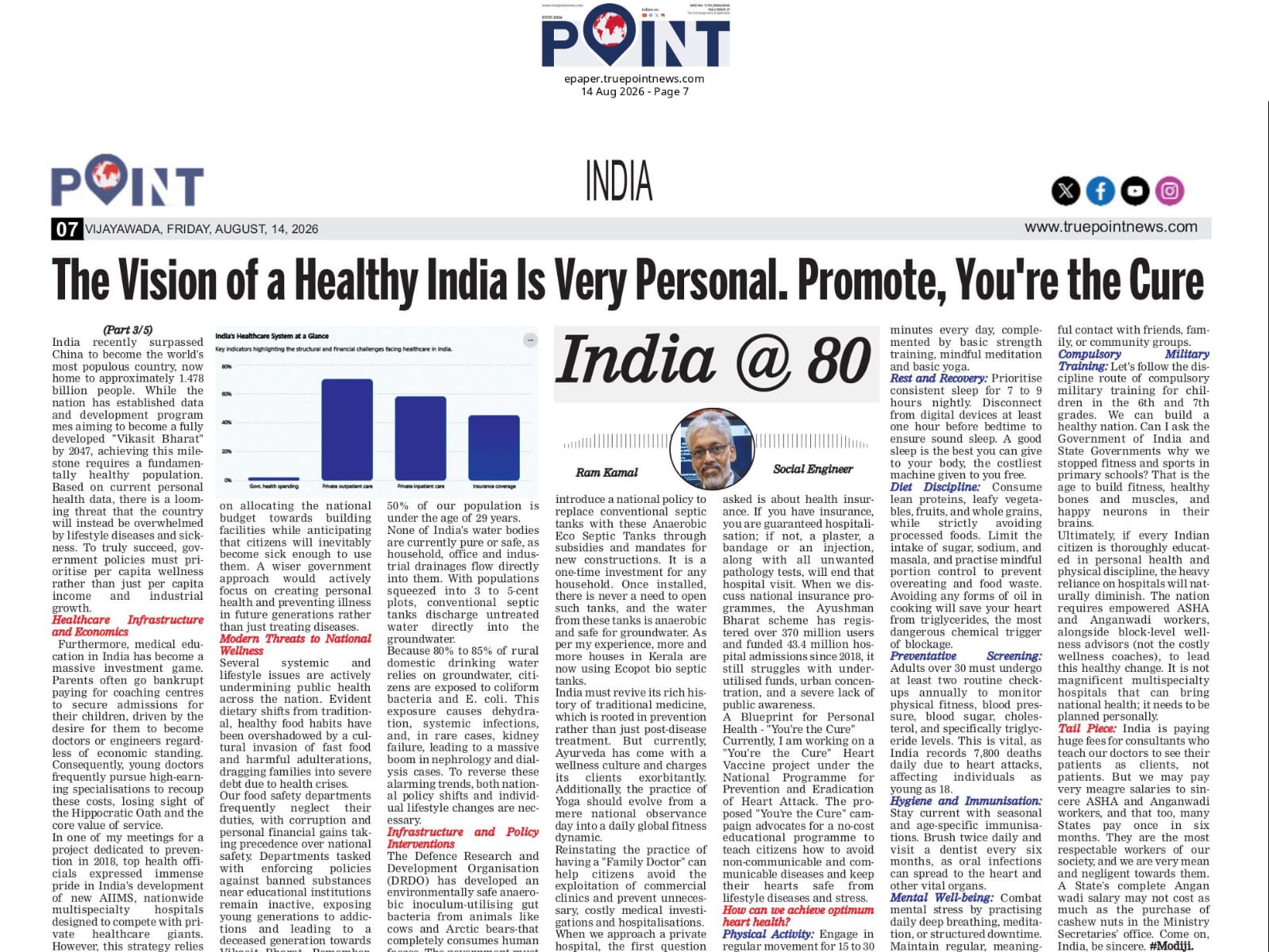
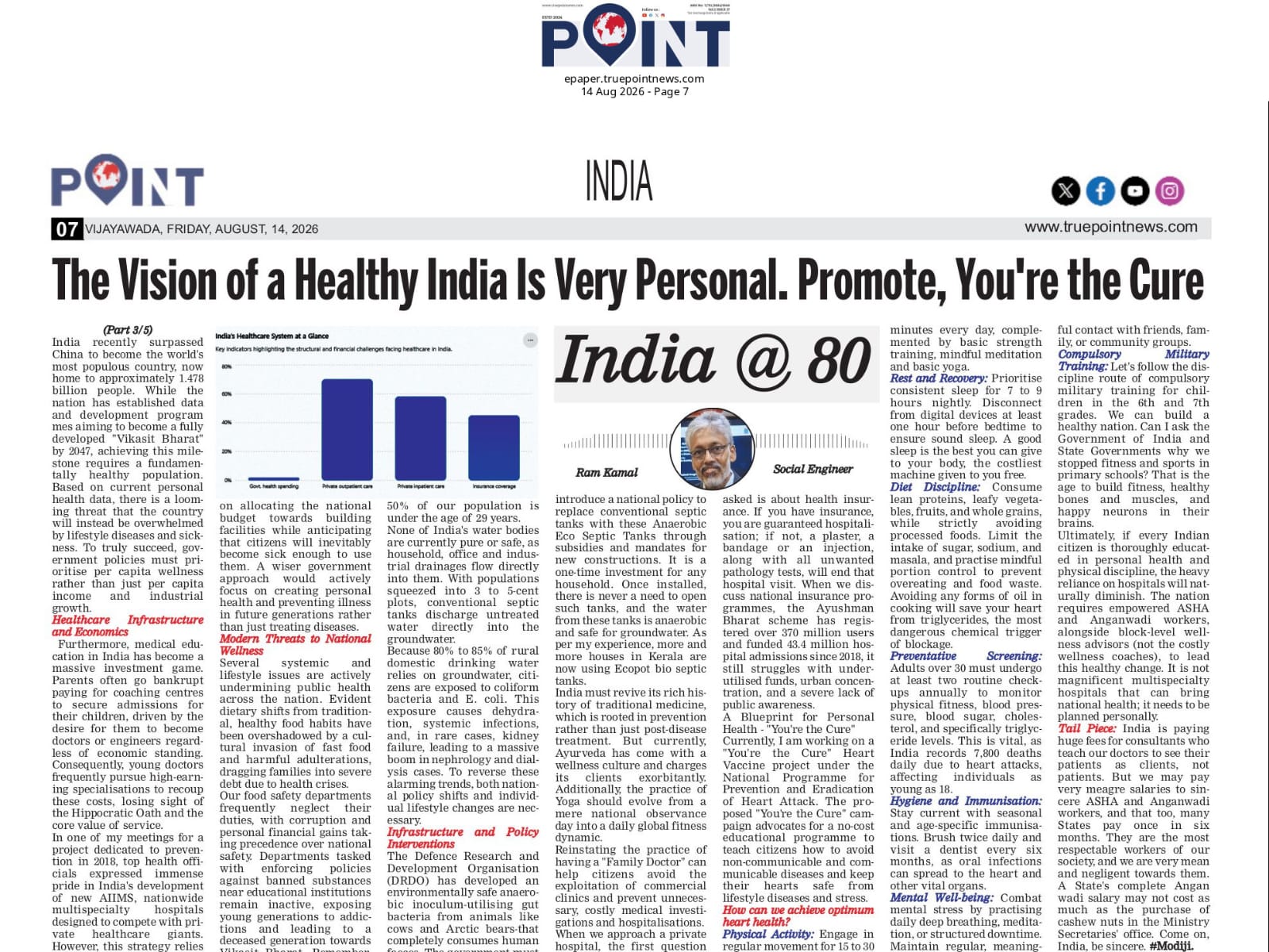
India's Healthcare System at a Glance
Key indicators highlighting the structural and financial challenges facing healthcare in India.
IndicatorPercentageGovt. health spending20%Private outpatient care80%Private inpatient care60%Insurance coverage20%
on allocating the national budget towards building facilities while anticipating that citizens will inevitably become sick enough to use them. A wiser government approach would actively focus on creating personal health and preventing illness in future generations rather than just treating diseases.
Modern Threats to National Wellness
Several systemic and lifestyle issues are actively undermining public health across the nation. Evident dietary shifts from traditional, healthy food habits have been overshadowed by a cultural invasion of fast food and harmful adulterations, dragging families into severe debt due to health crises.
Our food safety departments frequently neglect their duties, with corruption and personal financial gains taking precedence over national safety. Departments tasked with enforcing policies against banned substances near educational institutions remain inactive, exposing young generations to addictions and leading to a deceased generation towards Vikasit Bharat. Remember
50% of our population is under the age of 29 years. None of India's water bodies are currently pure or safe, as household, office and industrial drainages flow directly into them. With populations squeezed into 3 to 5-cent plots, conventional septic tanks discharge untreated water directly into the groundwater.
Because 80% to 8% of rural domestic drinking water relies on groundwater, citizens are exposed to coliform bacteria and E. coli. This exposure causes dehydration, systemic infections, and, in rare cases, kidney failure, leading to a massive boom in nephrology and dialysis cases. To reverse these alarming trends, both national policy shifts and individual lifestyle changes are necessary.
Infrastructure and Policy Interventions
The Defence Research and Development Organisation (DRDO) has developed an environmentally safe anaerobic inoculum-utilising gut bacteria from animals like cows and Arctic bears that
India @ 80
Ram Kamal
Social Engineer
introduce a national policy to replace conventional septic tanks with these Anaerobic Eco Septic Tanks through subsidies and mandates for new constructions. It is a one-time investment for any household. Once installed, there is never a need to open such tanks, and the water from these tanks is anaerobic and safe for groundwater. As per my experience, more and more houses in Kerala are now using Ecopot bio septic tanks.
India must revive its rich history of traditional medicine, which is rooted in prevention rather than just post-disease treatment. But currently, Ayurveda has come with a wellness culture and charges its clients exorbitantly. Additionally, the practice of Yoga should evolve from a mere national observance into a daily global fitness dynamic.
Reinstating the practice of having a "Family Doctor" can help citizens avoid the exploitation of commercial clinics and prevent unnecessary, costly medical investigations and hospitalisations. When we approach a private hospital, the first question
asked is about health insurance. If you have insurance, you are guaranteed hospitalisation; if not, a plaster, a bandage or an injection, along with all unwanted pathology tests, will end that hospital visit. When we discuss national insurance programme, the Ayushman Bharat scheme has registered over 370 million users and funded 43.4 million hospital admissions since 2018, it still struggles with under-utilised funds, urban concentration, and a severe lack of public awareness.
A Blueprint for Personal Health - "You're the Cure"
Currently, I am working on a "You're the Cure" Heart Vaccine project under the National Programme for Prevention and Eradication of Heart Attack. The proposed "You're the Cure" campaign advocates for a no-cost educational programme to teach citizens how to avoid non-communicable and commutable diseases and keep their hearts safe from lifestyle diseases and stress.
How can we achieve optimum heart health?
Physical Activity: Engage in regular movement for 15 to 30 minutes every day, complemented by basic strength training, mindful meditation and basic yoga.
Rest and Recovery: Prioritise consistent sleep for 7 to 9 hours nightly. Disconnect from digital devices at least one hour before bedtime to ensure sound sleep. A good sleep is the best you can give to your body, the costliest machine given to you free.
Diet Discipline: Consume lean proteins, leafy vegetables, fruits, and whole grains, while strictly avoiding processed foods. Limit the intake of sugar, sodium, and masala, and practise mindful portion control to prevent overeating and food waste. Avoiding any forms of oil in cooking will save your heart from triglycerides, the most dangerous chemical trigger of blockage.
Preventative Screening: Adults over 30 must undergo at least two routine check-ups annually to monitor physical fitness, blood pressure, blood sugar, cholesterol, and specifically triglyceride levels. This is vital, as India records 7,800 deaths daily due to heart attacks, affecting individuals as young as 18.
Hygiene and Immunisation: Stay current with seasonal and age-specific immunisations. Brush twice daily and visit a dentist every six months, as oral infections can spread to the heart and other vital organs.
Mental Well-being: Combat mental stress by practising daily deep breathing, meditation, or structured downtime. Maintain regular, meaningful contact with friends, family, or community groups.
Compulsory Military Training: Let's follow the discipline route of compulsory military training for children in the 6th and 7th grades. We can build a healthy nation. Can I ask the Government of India and State Governments why we stopped fitness and sports in primary schools? That is the age to build fitness, healthy bones and muscles, and happy neurons in their brains.
Ultimately, if every Indian citizen is thoroughly educated in personal health and physical discipline, the heavy reliance on hospitals will naturally diminish. The nation requires empowered ASHA and Anganwadi workers, alongside block-level wellness advisors (not the costly wellness coaches), to lead this healthy culture. It is not magnificent multispecialty hospitals that can bring national health; it needs to be planned personally.
Tail Piece: India is paying huge fees for consultants who teach our doctors to see their patients as clients, not patients. But we may pay very meagre salaries to sincere ASHA and Anganwadi workers, and that too, many States pay once in six months. They are the most respectable workers of our society, and we are very mean and negligent towards them. A State's complete Anganwadi salary may not cost as much as the purchase of cashew nuts in the Ministry Secretaries' office. Come on, India, be sincere. #Modiji.
End of screen-reader friendly text version.