Start of screen-reader friendly text version.
POINT
epaper.truepointnews.com
08 Aug 2026 - Page 6
E20 Petrol Transition in India: Know the Facts, Figures, and Consumer Concerns
Ram Kamal
Social Engineer
The recent implementation of E20 petrol, a blend of 20% ethanol and 80% pure petrol, has sparked significant debate across India. As the central government accelerates its nationwide rollout, consumers and experts alike are raising questions regarding its true benefits, vehicle compatibility, and long-term consequences. A new wave of protest is gathering momentum, threatening to bring unrest back to Delhi. Why rush the implementation now, only to inevitably backtrack and cut a sorry figure?
The Economic Paradox: Macro Gains vs. Micro Losses
From a macroeconomic perspective, the shift to E20 offers substantial benefits for the nation. By replacing 20% of standard fuel with domestically produced ethanol, India secures massive forex savings and reduces its heavy reliance on imported crude oil. This bolsters the country's energy security, buffering the economy against global market shocks, wars, and the steady depreciation of the Indian Rupee against the dollar.
However, at the microeconomic level, the everyday consumer currently bears the brunt. NITI Aayog had initially recommended that blended petrol should be sold at a lower price or with a tax differential to benefit the public. Yet, the government has ignored this recommendation. E20 is sold at the same price as pure petrol, offering zero financial relief to the buyer. Compounding this financial loss is the issue of fuel efficiency: studies indicate that E20 petrol yields 6% to 7% less mileage than pure petrol. Essentially, consumers are paying the same price for a fuel that takes them less distance, resulting in a direct financial loss.
Environmental and Agricultural Realities
Proponents argue that E20 burns cleaner, potentially lowering carbon emissions. However, because vehicles must burn a higher volume of E20 fuel to achieve the same mileage as pure petrol, the net reduction in total carbon emissions remains highly debatable.
On the agricultural front, ethanol production utilizes surplus crops like sugarcane and maize, providing an alternative income stream for farmers without threatening food security. Yet, ethanol production is highly water-intensive; it is estimated that producing just one liter of ethanol requires up to 10,000 liters of water. The extensive use of fertilizers for these crops poses additional environmental concerns that have yet to be thoroughly addressed.
The Compatibility Crisis and Engine Health
A major point of contention is vehicle compatibility. While vehicles manufactured in India from 2023 onwards are officially E20 compliant, older vehicles are not. Shockingly, it is estimated that only about 20% of petrol vehicles manufactured in the last 15 years are fully designed to handle E20 fuel. Because ethanol is a hygroscopic substance, meaning it naturally attracts moisture. If we leave E20 fuel idle can lead to water accumulation and severe internal corrosion. This moisture threatens vital engine components, including fuel lines, gaskets, O-rings, injectors, fuel pumps, and elastomers. The long-term damage this could inflict on non-compliant vehicles remains a massive worry for vehicle owners.
A Rushed Rollout?
Globally, transitioning to higher ethanol blends has been a slow, methodical process. Brazil took roughly 50 years to successfully transition to its current E30 standard. Similarly, the United States provided a 25-to-50-year transition window, allowing older vehicles the choice to continue using pure petrol while newer ones adapted to E15. In stark contrast, India is attempting to mandate this shift in a matter of months, abruptly stripping consumers of their choice.
The Way Forward:
To prevent widespread public backlash and protect consumer investments, the central government must take corrective steps:
- Provide Consumer Choice: Petrol stations should feature dedicated pumps for both pure petrol and E20, allowing owners of older vehicles to safely refuel. After all, prices are the same.
- Price Adjustments: E20 must be sold at a discounted rate to offset the guaranteed loss in mileage. Now, to compensate for the 6 to 7% loss per liter, consumer have to buy more Liters for their travel.
- Manufacturer Assurances: The government must coordinate with automakers and insurance companies to guarantee warranties and engine protection against ethanol-induced corrosion.
- Subsidized Spares: If corrosion occurs due to the government's policy shift, affected spare parts should be offered at discounted rates.
Ultimately, clear communication and a longer transition window are essential. Without providing citizens with choices and transparent reassurances, the E20 mandate risks becoming yet another well-intentioned policy marred by rushed implementation.
Visual Representation
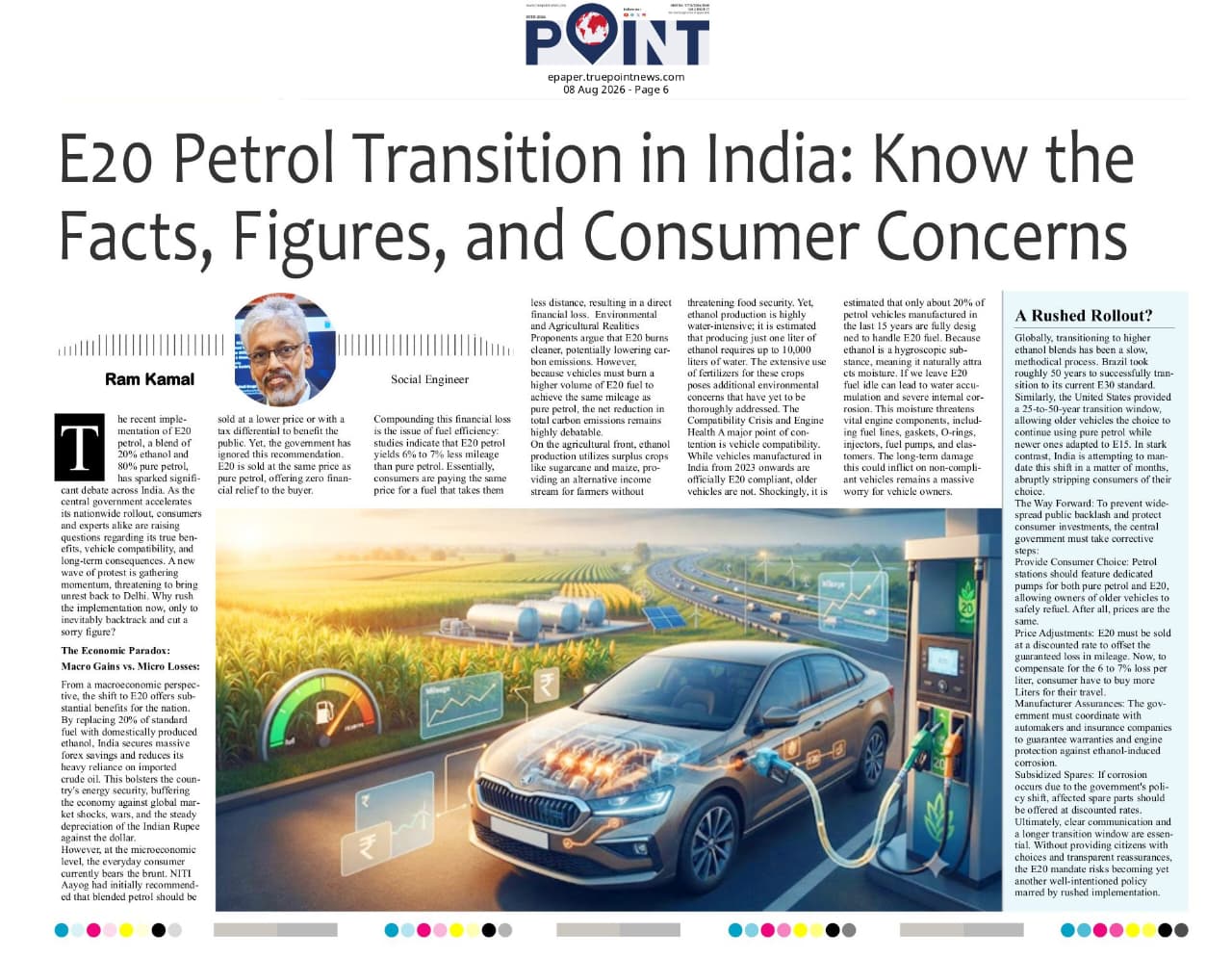
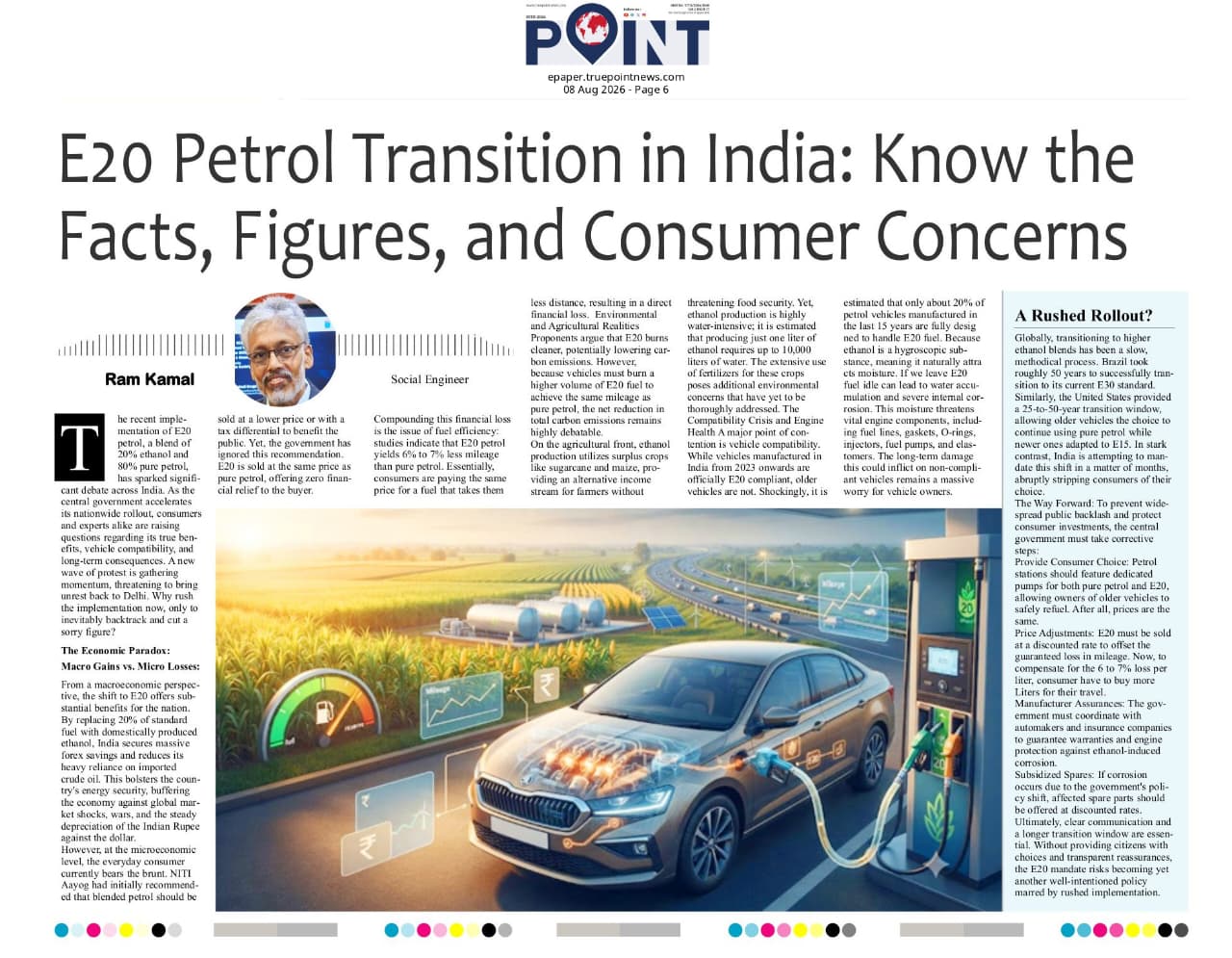
An editorial graphic runs along the bottom half of the article. On the left, a hand holds a yellow petrol pump nozzle with a leaf graphic and green rupee (₹) symbols floating nearby, illustrating the financial and environmental components. In the center, a blue SUV drives down an open highway bordered by green agricultural fields with wind turbines and solar panels under a warm yellow sky. On the right, a green fuel nozzle labeled '20' is shown fueling the SUV, emphasizing the E20 ethanol transition.
End of screen-reader friendly text version.