Start of screen-reader friendly text version.
Newspaper Header
Publication: POINT (epaper.truepointnews.com)
Date and Page: 17 Aug 2026 - Page 7
Politricks and Nationalism: India @ 80
By: Ram Kamal, Social Engineer
Visual Elements & Layout Description
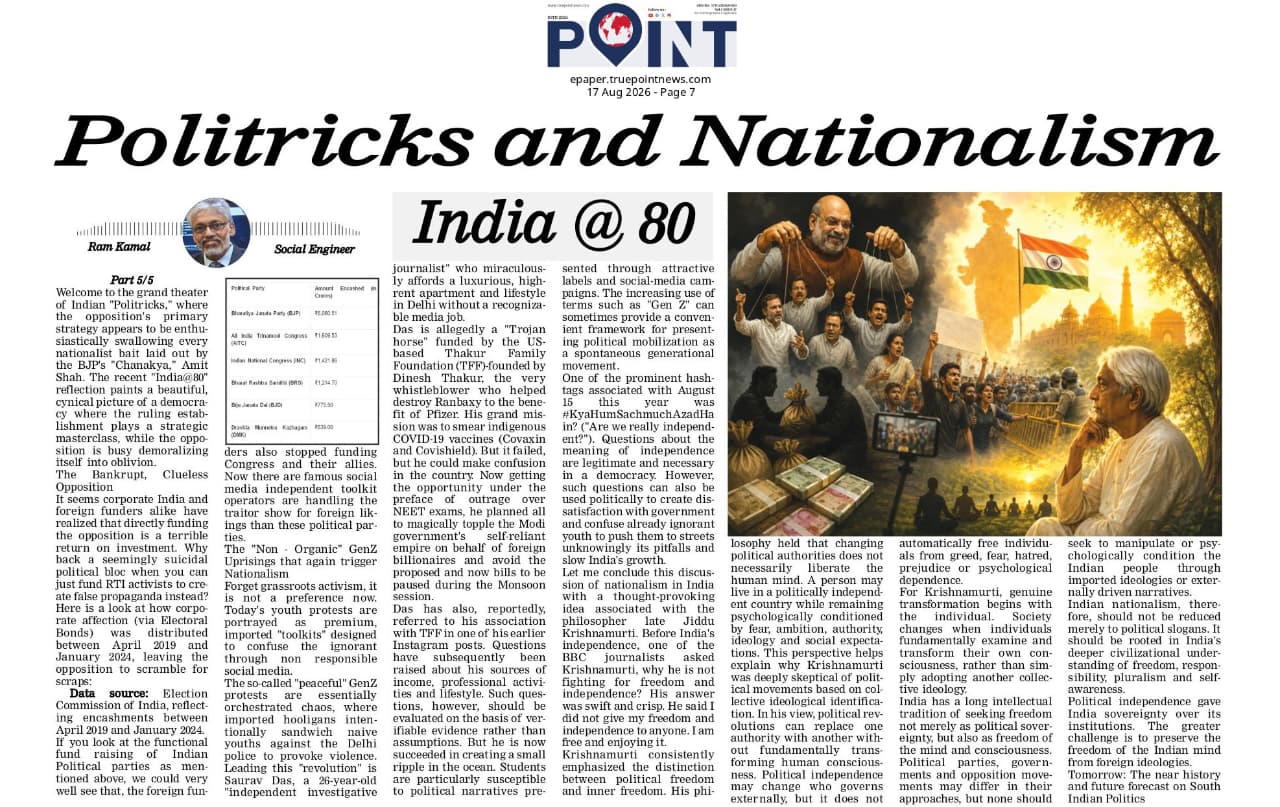
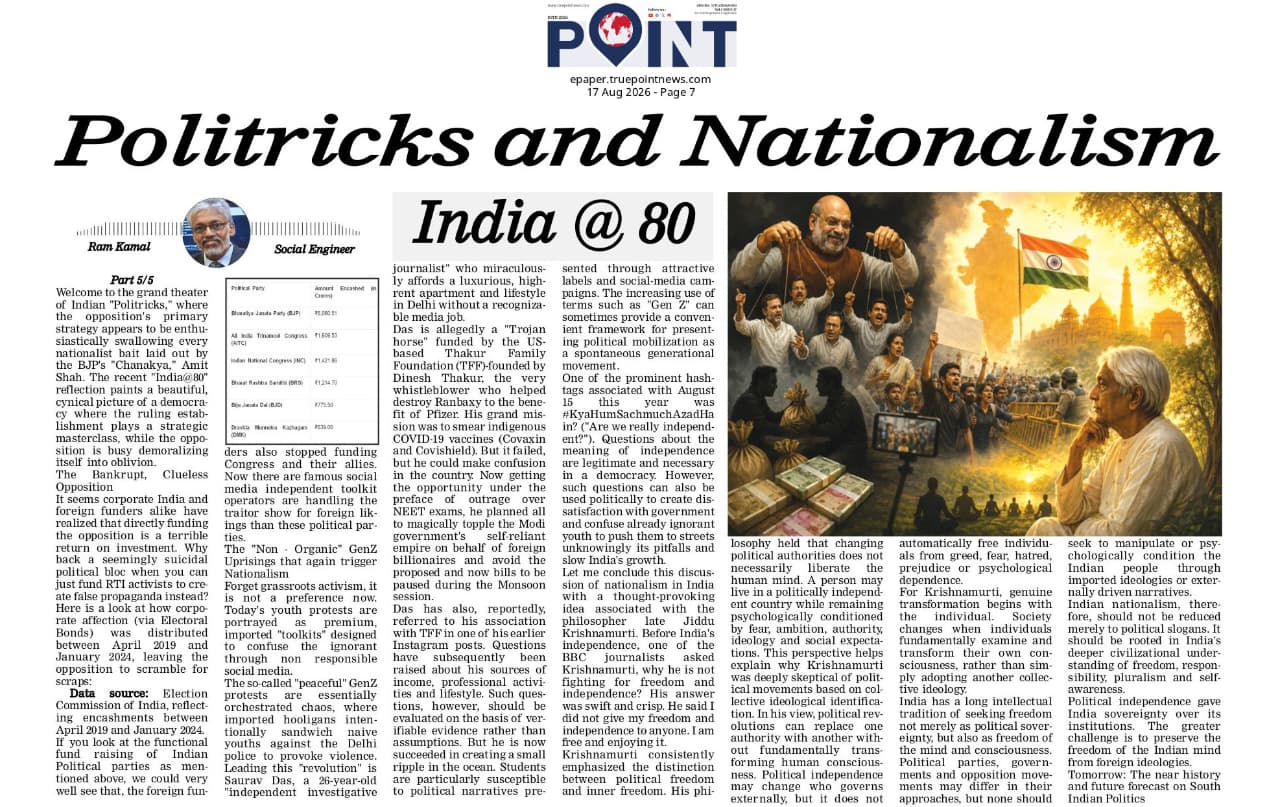
The image is a full-width editorial page layout from a newspaper. At the top, the masthead displays the 'POINT' logo, where the letter 'O' is depicted as a red circle containing a blue pointing hand symbol. Below this is the main title, 'Politricks and Nationalism,' printed in a large, bold serif font. A smaller subtitle reads 'India @ 80'. The article is written in a multi-column format. On the top left is an author profile header for 'Ram Kamal, Social Engineer' along with a small circular portrait of a man in glasses. Below the introduction in the first column, a data table details the encashment of electoral bonds by political parties. On the right, a large color photograph shows a crowd of people waving the Indian national flag (the Tricolour) at sunset, gathered before a silhouette of a historic monument (such as the Red Fort), with a central figure in a white kurta being cheered by the crowd.
Article Content
Part 5/5
Welcome to the grand theater of Indian "Politricks," where the opposition's primary strategy appears to be enthusiastically swallowing every nationalist bait laid out by the BJP's "Chanakya," Amit Shah. The recent "India@80" reflection paints a beautiful, cynical picture of a democracy where the ruling establishment plays a strategic masterclass, while the opposition is busy demoralizing itself into oblivion.
The Bankrupt, Clueless Opposition
It seems corporate India and foreign funders alike have realized that directly funding the opposition is a terrible return on investment. Why back a seemingly suicidal political bloc when you can just fund RTI activists to create false propaganda instead? Here is a look at how corporate affection (via Electoral Bonds) was distributed between April 2019 and January 2024, leaving the opposition to scramble for scraps:
Electoral Bonds Distribution Table
Political PartyAmount Encashed (in Crores)Bharatiya Janata Party (BJP)₹ 10,000.51All India Trinamool Congress (AITC)₹ 1,600.55Indian National Congress (INC)₹ 1,421.86Bharat Rashtra Samithi (BRS)₹ 1,214.70Biju Janata Dal (BJD)₹ 775.50Dravida Munnetra Kazhagam (DMK)₹ 639.00
...ders also stopped funding Congress and their allies. Now there are famous social media independent toolkit operators are handling the traitor show for foreign likings than these political parties.
The "Non - Organic" GenZ Uprisings that again trigger Nationalism
Forget grassroots activism, it is not a preference now. Today's youth protests are portrayed as premium, imported "toolkits" designed to confuse the ignorant through non responsible social media. The so-called "peaceful" GenZ protests are essentially orchestrated chaos, where imported hooligans intentionally sandwich naive youths against the Delhi police to provoke violence. Leading this "revolution" is Saurav Das, a 26-year-old "independent investigative journalist" who miraculously affords a luxurious, high-rent apartment and lifestyle in Delhi without a recognizable media job.
Das is allegedly a "Trojan horse" funded by the US-based Thakur Family Foundation (TFF)-founded by Dinesh Thakur, the very whistleblower who helped destroy Ranbaxy to the benefit of Pfizer. His grand mission was to smear indigenous COVID-19 vaccines (Covaxin and Covishield). But it failed, but he could make confusion in the country. Now getting the opportunity under the preface of outrage over NEET exams, he planned all to magically topple the Modi government's self-reliant empire on behalf of foreign billionaires and avoid the proposed and now bills to be paused during the Monsoon session.
Das has also, reportedly, referred to his association with TFF in one of his earlier Instagram posts. Questions have subsequently been raised about his sources of income, professional activities and lifestyle. Such questions, however, should be evaluated on the basis of verifiable evidence rather than assumptions. But he is now succeeded in creating a small ripple in the ocean. Students are particularly susceptible to political narratives presented through attractive labels and social-media campaigns. The increasing use of terms such as "Gen Z" can sometimes provide a convenient framework for presenting political mobilization as a spontaneous generational movement.
One of the prominent hashtags associated with August 15 this year was #KyaHumSachmuchAzadHain? ("Are we really independent?"). Questions about the meaning of independence are legitimate and necessary in a democracy. However, such questions can also be used politically to create dissatisfaction with government and confuse already ignorant youth to push them to streets unknowingly its pitfalls and slow India's growth.
Let me conclude this discussion of nationalism in India with a thought-provoking idea associated with the philosopher late Jiddu Krishnamurti. Before India's independence, one of the BBC journalists asked Krishnamurti, why he is not fighting for freedom and independence? His answer was swift and crisp. He said I did not give my freedom and independence to anyone. I am free and enjoying it.
Krishnamurti consistently emphasized the distinction between political freedom and inner freedom. His philosophy held that changing political authorities does not necessarily liberate the human mind. A person may live in a politically independent country while remaining psychologically conditioned by fear, ambition, authority, ideology and social expectations. This perspective helps explain why Krishnamurti was deeply skeptical of political movements based on collective ideological identification. In his view, political revolutions can replace one authority with another without fundamentally transforming human consciousness. Political independence may change who governs externally, but it does not automatically free individuals from greed, fear, hatred, prejudice or psychological dependence.
For Krishnamurti, genuine transformation begins with the individual. Society changes when individuals fundamentally examine and transform their own consciousness, rather than simply adopting another collective ideology. India has a long intellectual tradition of seeking freedom not merely as political sovereignty, but also as freedom of the mind and consciousness. Political parties, governments and opposition movements may differ in their approaches, but none should seek to manipulate or psychologically condition the Indian people through imported ideologies or externally driven narratives.
Indian nationalism, therefore, should not be reduced merely to political slogans. It should be rooted in India's deeper civilizational understanding of freedom, responsibility, pluralism and self-awareness. Political independence gave India sovereignty over its institutions. The greater challenge is to preserve the freedom of the Indian mind from foreign ideologies.
Tomorrow: The near history and future forecast on South Indian Politics
End of screen-reader friendly text version.